In this article
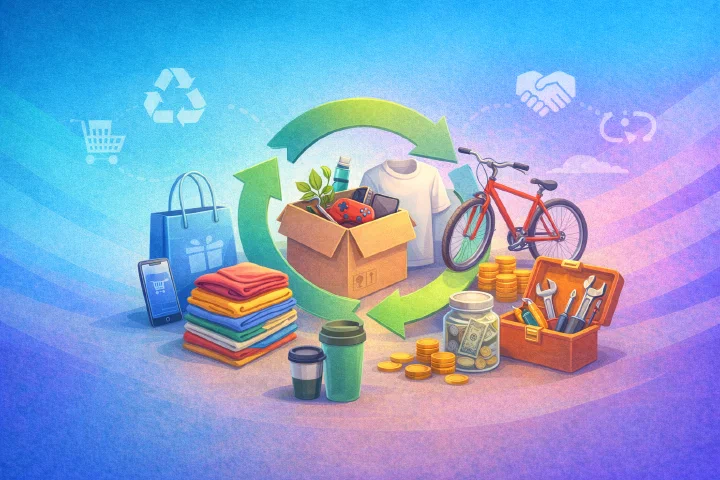
Did you know that, according to research, the average household has over $3,000 worth of unused items? Clothes that no longer fit, electronics forgotten in drawers, books already read, furniture that has lost its purpose — all of this is idle money. The circular economy is the practice of transforming this “waste” into income, and rethinking the consumption cycle to spend less, earn more, and help the planet at the same time.
The circular economy goes far beyond simply “selling used stuff.” It is a mindset shift that questions the traditional buy-use-discard cycle and proposes a model where products have longer lifespans, are shared, repaired, and reused. And the best part: besides being sustainable, it is extremely beneficial for your wallet.
In this article, we will show you how to make money from what you already own, where to sell, how to trade, when to repair, and how this philosophy can permanently transform your relationship with consumption and money.
What Is the Circular Economy (And Why It Matters for Your Wallet)
In the traditional consumption model (linear), the cycle is simple: extract, produce, consume, discard. You buy something new, use it for a while, and throw it away. In the circular model, the goal is to keep products and materials in use for as long as possible.
In practice, for your personal finances, this means:
- Buy less (and better)
- Sell what you do not use (generating income)
- Trade instead of buying (direct savings)
- Repair instead of replacing (significant savings)
- Rent instead of owning (for rarely used items)
Real financial impact
| Action | Estimated savings/earnings per year |
|---|---|
| Sell used clothes and accessories | $200 - $800 |
| Sell unused electronics | $200 - $1,000 |
| Trade books and games | $100 - $300 |
| Repair instead of replace (phone, appliances) | $300 - $1,500 |
| Buy used (clothes, furniture, electronics) | $500 - $3,000 |
| Rent instead of buy (tools, formal wear) | $200 - $600 |
| TOTAL POTENTIAL | $1,500 - $7,200/year |
How to Sell Used Items: Complete Platform Guide
The first and most direct way to participate in the circular economy is selling what you no longer use. Each platform has its advantages:
General marketplaces
eBay
- Best for: Electronics, collectibles, clothing, virtually anything
- Advantages: Massive buyer base, auction and fixed-price options
- Tips: Quality photos and detailed descriptions drive higher prices
- Commission: 10-13% of sale price
Facebook Marketplace
- Best for: Furniture, large items, local sales
- Advantages: No commission, local audience, integrated with Facebook
- Tips: Respond quickly. Local buyers value speed
- Commission: Free
Craigslist
- Best for: Furniture, appliances, local pickup items
- Advantages: No fees, straightforward listings
- Tips: Meet in public places for safety. Cash preferred for simplicity
- Commission: Free (most categories)
Specialized platforms
| Platform | Specialty | Commission |
|---|---|---|
| Poshmark | Clothing, shoes, accessories | 20% |
| ThredUp | Clothing (send-in model) | 3-80% of selling price |
| Decluttr | Electronics, phones, games | Fixed price offer |
| Mercari | General (easy shipping) | 10% |
| Vinted | Clothing, accessories | Buyer pays fees |
| BookScouter | Textbooks and books | Varies |
Local community groups
Do not underestimate the power of local groups. Many sales happen in:
- Neighborhood groups (“Buy/Sell [Neighborhood Name]”)
- Parents’ groups (children’s clothing, toys)
- Niche groups (gaming, books, musical instruments)
- Building/condo groups (furniture, appliances)
Advantage: Zero commission, in-person delivery, direct negotiation.
Tips for Selling Faster and for Better Prices
The difference between a listing that sells in 1 day and one that sits for months is in the details:
Photos that sell
- Take photos with good lighting (natural light is best)
- Clean background (white wall or organized surface)
- Show multiple angles (front, back, details, defects)
- Size reference (place something recognizable next to small items)
- Minimum 4 photos per listing
Descriptions that convince
- Be honest about defects (builds trust and prevents returns)
- Include measurements and technical specifications
- Explain the reason for selling (“moving,” “upgrading,” “no longer needed”)
- Mention the original price and the discount percentage
Smart pricing
- Electronics: 40-70% of new price (depending on condition and age)
- Brand-name clothing: 20-50% of original price
- Furniture: 30-60% of new price
- Books: 30-50% of cover price
- Appliances: 40-65% of new price
Golden rule: Research the price of the same item on the marketplace before setting yours. If there are 10 identical listings, price 5-10% below to sell faster.
Trade Groups: Savings Without Spending a Dime
Trading is the purest form of circular economy. You give something you do not need and receive something you do, with no money involved.
Popular types of trading
Clothing swaps
- In-person events where each person brings items and “shops” with tokens
- How it works: 1 item brought = 1 token = 1 item taken
- Where to find: Instagram (#clothingswap), Facebook groups, local events
Book exchanges
- Community bookshelves (in parks, cafes, coworking spaces)
- Online exchange clubs
- Little Free Libraries in neighborhoods
Service exchanges (time banking)
- You offer a skill (English lessons, repairs, photography)
- In exchange, you receive another skill (haircut, music lessons, gardening)
- Platforms like TimeRepublik organize these exchanges
Children’s toy swaps
- Especially useful because children lose interest quickly
- Parent groups are the best channels
- Estimated savings: $300-800/year per family
Repair Instead of Replace: The Hidden Savings
We live in a throwaway culture: it broke, buy a new one. But repairing can be dramatically cheaper and is one of the most important practices in the circular economy.
Comparison: Repair vs. Replace
| Item | Repair cost | New item cost | Savings |
|---|---|---|---|
| Phone screen | $50 - $150 | $400 - $1,200 | Up to 87% |
| Washing machine | $100 - $250 | $500 - $1,200 | Up to 79% |
| Sofa (reupholster) | $200 - $600 | $800 - $3,000 | Up to 80% |
| Shoes (cobbler) | $15 - $50 | $80 - $250 | Up to 80% |
| Clothing (tailor) | $10 - $40 | $50 - $200 | Up to 80% |
| Bicycle | $30 - $100 | $300 - $1,000 | Up to 90% |
When is it worth repairing?
The practical rule is: if the repair costs less than 50% of a new item’s price, repair it. Exceptions:
- Very old equipment with hard-to-find parts
- Items with safety risks (electrical, gas installations)
- When repairs are recurring (the item keeps breaking)
DIY (Do It Yourself)
Many simple repairs can be done at home with YouTube tutorials:
- Basic sewing (hems, buttons, small tears)
- Furniture painting (refresh instead of buying new)
- Simple part replacements (faucets, outlets, door handles)
- Deep cleaning of electronics (laptops, gaming consoles)
Thrift Shopping: Buying Used Is Smart
The other side of the circular economy is buying used. Thrift stores (physical and online) offer quality products for a fraction of the original price.
Categories where buying used makes the most sense
| Category | Typical savings | Where to buy |
|---|---|---|
| Brand-name clothing | 60-80% off | Poshmark, thrift stores, Vinted |
| Furniture | 50-70% off | Facebook Marketplace, estate sales |
| Books | 50-70% off | ThriftBooks, used bookstores |
| Refurbished electronics | 30-50% off | Amazon Renewed, manufacturer outlets |
| Children’s items | 60-80% off | Parent groups, children’s consignment |
| Musical instruments | 40-60% off | Reverb, local music shops |
Tip: Children’s clothing is the best deal in the secondhand market. Kids grow fast, so many items are practically new.
Rent Instead of Own
For rarely used items, renting is much smarter than buying:
- Tools — Drill, saw, sander (used a few times per year)
- Formal wear — Platforms like Rent the Runway, HURR
- Camping equipment — Tents, sleeping bags
- Sports equipment — Surfboards, bikes for travel
- Event decorations — Tables, chairs, lighting
Average savings: 70-90% compared to purchasing.
Organizing Your “Big Sale”
Want to start now? Here is a step-by-step plan to turn your unused items into cash:
Week 1: The Big Inventory
Go through each room in your house and sort items into 4 categories:
- Sell — Items in good condition with resale value
- Trade — Items in good condition that can be exchanged for something useful
- Donate — Items in good condition without significant resale value
- Discard — Damaged items beyond viable repair
Week 2: Photograph and List
- Take photos of all items in the “Sell” category
- Research market prices
- Create listings on appropriate platforms
- Share in local groups
Weeks 3-4: Negotiate and Deliver
- Respond quickly to messages
- Be flexible in negotiation (selling at 10% discount is better than not selling)
- Arrange safe deliveries (public places for in-person sales)
- Record all sales for financial tracking
Expected result
A typical “big sale” yields between $300 and $3,000, depending on what you have at home. Many people are surprised by the amount of money “hidden” in their belongings.
How Monely Can Help
Monely is perfect for tracking circular economy earnings and turning this practice into a financial habit. Here is how to use it:
- Create a “Sales/Extra Income” category to record all income generated from selling used items
- Set goals for your earnings — “I want to earn $1,000 selling items by December”
- Track savings from used purchases vs. new — See how much you are saving by shopping secondhand
- Record repairs in the maintenance category and compare with replacement costs
- Use quick logging via WhatsApp — Sold something? Record it instantly through the AI assistant
- Visualize the total impact — At the end of the month, see how much the circular economy contributed to your finances
With Monely, every sale, trade, and repair becomes part of a visible and motivating financial strategy.
Circular Economy as a Lifestyle
The circular economy is not something you do once — it is a mindset change that, once adopted, permanently transforms your relationship with consumption. Here are the principles to incorporate daily:
Before buying something new, ask yourself:
- Do I really need this?
- Can I borrow or rent it?
- Is there a used version in good condition?
- If I buy new, will I use it for at least 2 years?
- When I no longer need it, can I resell it?
The virtuous cycle
When you adopt the circular economy, a positive cycle emerges:
Buy less -> Spend less -> Sell what you do not use -> Earn money -> Invest -> Wealth grows -> More financial freedom
This cycle is the opposite of traditional consumerism, where you buy more, spend more, sell nothing, and money simply disappears.
The circular economy is not just an environmental trend — it is one of the most effective strategies for improving your personal finances. By selling what you do not use, trading what you can, repairing what is worth it, and buying used when it makes sense, you can save (and earn) thousands of dollars per year.
Download Monely and start tracking your circular economy gains today. Monitor every sale, every saving, and see the real impact of this mindset change on your finances.