In this article
Central banks around the world are developing digital currencies — known as CBDCs (Central Bank Digital Currencies). Brazil is no exception. The country’s version is called Drex, and it’s one of the most advanced CBDC projects globally.
But whether it’s Brazil’s Drex, Europe’s Digital Euro, China’s Digital Yuan, or any other CBDC in development, the fundamental questions are the same: What is it? How does it work? And what does it actually change for ordinary people?
In this guide, we’ll break it all down in plain language: what CBDCs really are, how they work, what changes for you, and why it’s worth paying attention.
What Is the Drex (and What Is a CBDC)
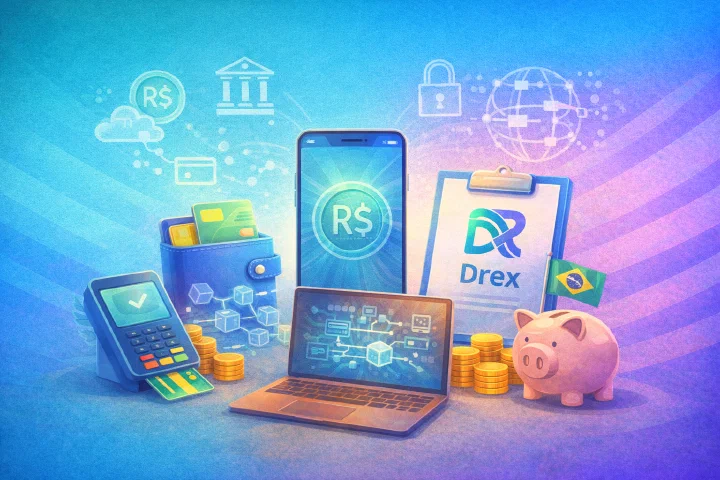
Drex is Brazil’s central bank digital currency. In simple terms, it’s a digital version of the Brazilian Real that exists on a platform operated by the Central Bank, built on distributed ledger technology (DLT) similar to blockchain.
What this means in practice
Today, when you have $1,000 in your bank account, that money exists as a record in the bank’s system. With a CBDC like Drex, that same value would exist as a digital token on the central bank’s platform, with the same guarantee and the same value as the currency you already know.
Drex is NOT…
| What people think | The truth |
|---|---|
| A cryptocurrency like Bitcoin | It’s an official government currency, regulated and with stable value |
| A replacement for instant payment systems | Instant payments are a transfer system; Drex is a form of money |
| The end of physical cash | Bills and coins will continue to exist |
| An investment | It’s not for speculation; 1 Drex = 1 Real, always |
| Something mandatory | Nobody will be forced to use it |
How the Drex Works
The two-layer structure
Brazil’s Central Bank designed Drex to operate in two layers:
Layer 1 — Wholesale (between institutions)
- Banks and financial institutions use Drex among themselves to settle transactions
- It works as a more efficient clearinghouse
- Regular citizens don’t interact with this layer directly
Layer 2 — Retail (you and me)
- You would access Drex through your trusted bank or financial institution
- The experience would be similar to the mobile banking app you already use
- The bank converts your currency into Drex tokens when needed
Smart contracts: the real game-changer
The true differentiator of Drex isn’t being “digital” — our money is already digital in practice. The real innovation is smart contracts, which allow programming transactions with automatic conditions.
Practical examples:
- Real estate purchase: The money is locked in an automatic escrow. When the registry confirms the property transfer, payment is automatically released to the seller. No intermediaries, no waiting days
- Vehicle purchase: Payment and document transfer happen simultaneously, with no risk of one side fulfilling their part while the other doesn’t
- Insurance: If a condition is met (e.g., confirmed flight delay), the claim payment is released automatically
What Changes in Your Life
Short term: not much
If Drex launched tomorrow, your daily finances wouldn’t change dramatically. You’d still:
- Use instant payment systems for everyday transfers
- Use credit/debit cards for purchases
- Receive your salary the same way
Medium term: cheaper and faster operations
With Drex fully operational, you’d likely notice:
- Cheaper inter-bank transfers: direct settlement reduces costs for institutions, which could mean lower fees for you
- Simpler buying and selling of assets: investments, property, and vehicles with less red tape
- Access to new financial products: like tokenized investments (fractional real estate ownership, for example)
Long term: a new way of thinking about money
- Programmable money: imagine receiving a government benefit that can only be spent on food — the money itself “knows” where it can be used
- Financial inclusion: people without bank accounts could access basic financial services
- International transactions: cheaper and faster cross-border transfers
CBDC vs. Instant Payments: What’s the Difference?
This is the most common confusion, so let’s clear it up:
| Feature | Instant payments (e.g., Pix) | CBDC (e.g., Drex) |
|---|---|---|
| What it is | Payment system | Form of money |
| Analogy | Like the postal service (delivers) | Like the letter (what gets delivered) |
| Speed | Instant | Depends on the operation |
| Primary use | Day-to-day payments and transfers | Complex operations with smart contracts |
| Status | Already operational | In testing/pilot phase |
| For whom | Everyone | Initially, larger operations |
In practice, instant payments and CBDCs will coexist. Instant transfers remain the best option for coffee, restaurant bills, and sending money to a friend. CBDCs shine in more complex operations that today require notaries, intermediaries, and days of waiting.
CBDC vs. Cryptocurrencies: Are They the Same?
No. The differences are fundamental:
| Feature | CBDC (Drex) | Cryptocurrencies (Bitcoin, etc.) |
|---|---|---|
| Issuer | Central bank | Decentralized (no one controls it) |
| Value | 1 Drex = 1 Real (fixed) | Volatile (can rise or fall 50% in a day) |
| Regulation | Fully regulated | Varied regulation by country |
| Privacy | Central bank can track transactions | Pseudonymous or anonymous |
| Purpose | Official payment method | Investment/store of value |
Concerns and Risks
Privacy
The most common concern: “Will the government be able to track everything I spend?” It’s a legitimate worry. The Central Bank says privacy protections will be in place, but the exact level is still being defined.
What we know: The central bank will have access to transaction data, but says it will follow the same banking secrecy rules that already exist. In practice, governments already have access to information about financial movements above certain thresholds — CBDCs don’t substantially change this.
Cybersecurity
A centralized digital money platform is, by definition, an attractive target for hackers. The Central Bank is investing heavily in security, but no system is 100% invulnerable.
Digital exclusion
Millions of people worldwide still lack regular internet access. If CBDCs become dominant, these people could be left behind. That’s why maintaining physical cash is essential.
Timeline: When Does Drex Arrive
| Phase | Period | What happens |
|---|---|---|
| Internal testing | 2023-2024 | Pilot with financial institutions |
| Expanded testing | 2025-2026 | More participants, real use cases |
| Gradual launch | 2027+ | Available to the general public |
The Central Bank has been cautious — and that’s a good thing. A poorly implemented digital currency can cause serious problems. Better to take time and get it right than to rush and create chaos.
How to Prepare
Even though Drex isn’t fully available yet, here are things you can do now:
1. Keep your digital finances organized
CBDCs will make the financial ecosystem more digital. The more organized your digital financial life is now, the more prepared you’ll be.
2. Know your digital banks
The institutions participating in Drex testing are mostly large banks and fintechs. Having accounts at institutions on the cutting edge could mean early access.
3. Don’t fall for scams
With any new technology, scammers will create “CBDC investments,” “token pre-sales,” and other frauds. Remember: Drex is not an investment and won’t be sold before its official launch.
How Monely Can Help
The Drex will add another layer to the financial ecosystem — another account, another way to move money. And the more options exist, the greater the need for control.
Monely already supports multiple accounts, which means when Drex becomes available, you’ll be able to add a “Drex account” and track all movements alongside your other bank accounts, cards, and investments.
Plus, with support for multiple payment methods, Monely is ready for an increasingly digital financial world — helping you keep everything organized in one place.
Conclusion
Drex isn’t a revolution that will change your life overnight. It’s a gradual evolution of the financial system that will make certain operations cheaper, faster, and more secure.
The most important thing right now is to understand the concept and avoid misinformation and scams. Drex will arrive at its own pace, and when it does, it will be another tool in your financial arsenal — not a replacement for everything that already exists.
Keep your finances organized, stay informed about developments, and when Drex finally becomes available, you’ll be ready to take advantage of its benefits.
Next steps: While CBDCs are still rolling out, organize your digital finances in Monely. Register all your accounts and payment methods in one place — that way, when the digital currency arrives, adding one more account will be simple and seamless.