In this article
Have you ever bought a stock or cryptocurrency just because “everyone was talking about it”? Or sold your investments in panic when you saw news of a market crash? If you answered yes, you’re not alone: studies show that about 70% of individual investors make decisions influenced by majority behavior, often ignoring their own analysis or strategy.
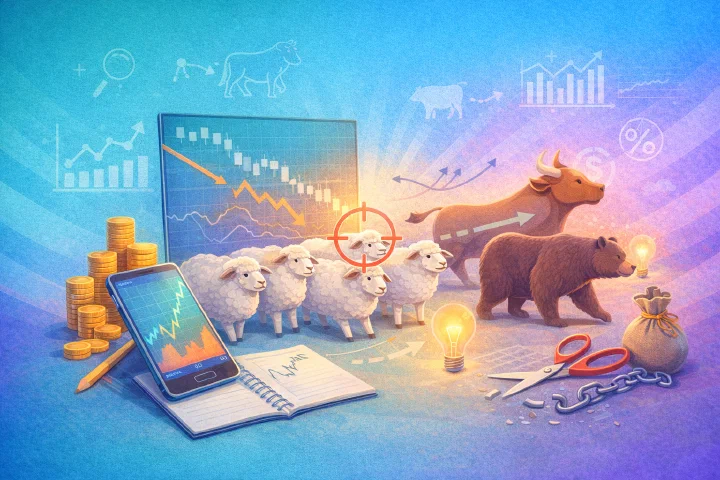
This phenomenon has a name: herd mentality in investing. It’s a behavioral bias that leads us to copy others’ financial decisions, believing that “if many people are doing it, it must be right.” The problem? The herd is frequently wrong, especially at the market’s most critical moments — and following the crowd can cost your portfolio dearly.
In this article, we’ll understand why our brain pushes us toward herd behavior, how it manifests in investments, and most importantly, how to develop your own strategy based on your profile and goals, not what everyone else is doing.
What Is Herd Mentality in Investing
Herd mentality (or herd behavior) is a psychological tendency to follow the majority’s actions, especially in uncertain situations. In investing, this means buying when everyone is buying and selling when everyone is selling, regardless of economic fundamentals or your own strategy.
Why Does Our Brain Do This?
There are deep evolutionary and psychological reasons:
Evolutionary reasons:
- Following the group increased ancestral survival chances
- Disagreeing with the majority meant risk of social exclusion
- Mental shortcut: “thousands of people can’t be wrong”
Modern psychological reasons:
- FOMO (Fear of Missing Out): fear of missing opportunities others are seizing
- Social validation: seeking approval and group belonging
- Regret aversion: preference to be wrong with everyone than right alone
- Collective overconfidence: the illusion that group decisions are safer
Herd mentality triggers:
| Trigger | How It Manifests | Real Example |
|---|---|---|
| Sensationalist media | Headlines about “new investment craze” | “Bitcoin soars 200% and could reach $50,000” |
| Influencers | “Hot tips” from gurus on social media | “I bought this stock and made 500% in 1 month” |
| Social conversations | Friends/family talking about recent gains | “My cousin made $20,000 with NFTs” |
| Collective panic | Sudden drops generating mass selling | March 2020 crash at pandemic start |
| Market momentum | Assets rising attracting more buyers | Dot-com bubble (1999-2000) |
The fundamental problem: herd mentality makes you enter the market when prices are at the top (everyone buying) and exit when they’re at the bottom (everyone selling) — exactly the opposite of what you should do.
How Herd Mentality Damages Your Investments
The consequences of this bias can be devastating to your wealth. Let’s see the main dangers:
1. Buying Overvalued Assets
When “everyone” is buying something, prices have already risen far beyond real value. You enter at the bubble’s top, paying dearly for something that will soon fall.
Recent American example: In 2021, during the cryptocurrency boom, Bitcoin reached $69,000 in the US. Thousands of novice investors entered at this moment, influenced by Reddit groups, influencers, and news. In 2022, Bitcoin fell to $15,600 — a drop of 77%. Those who followed the herd at the top lost most of their investment.
2. Selling at the Worst Possible Time
Herd mentality works both ways. When the market drops, collective panic leads investors to sell quickly, crystallizing losses that could be temporary.
US market data: During the March 2020 crash, when the S&P 500 fell 34% in one month, approximately 60% of retail investors sold their positions in panic. Those who held or bought more stocks recovered their wealth and profited: the index recovered all value in less than 5 months and rose another 68% in 2021.
3. Ignoring Your Risk Profile
Following the herd makes you forget who you are as an investor. Your conservative or moderate profile gets trampled by collective excitement.
Common scenario:
- You have $50,000 in savings bonds and CDs (conservative profile)
- You see friends profiting from tech stocks
- You put $40,000 in day trading without experience
- You lose $20,000 in 3 months
- Your emergency fund is compromised
4. Speculative Bubbles and Crashes
Herd mentality is the fuel of financial bubbles. History is full of examples:
Historic bubbles driven by herd mentality:
| Bubble | Period | What Happened | Result |
|---|---|---|---|
| Dutch Tulips | 1636-1637 | Tulip bulbs worth more than houses | 99% crash in weeks |
| Dot-com Bubble | 1999-2000 | Any company with “.com” worth billions | Nasdaq fell 78% |
| US Subprime | 2006-2008 | “Real estate always goes up” — easy credit | Global financial crisis |
| GameStop | 2021 | Reddit vs Wall Street — stock rose 2,500% | 90% drop after |
In the US, we saw smaller bubbles with meme stocks (AMC, GameStop) in 2020-2021, which rose 1,000-2,500% and then fell 80-90%.
5. Excessive Costs and Fees
Herd mentality leads to frequent operations: buy, sell, buy again. This generates:
- Trading commissions (if your broker charges)
- Capital gains taxes on short-term profits (up to 37% federal + state)
- Bid-ask spread (difference between buy and sell price)
- Exchange fees (SEC, FINRA)
Practical example:
- Investor buys and sells 10 times in one year following “hot tips”
- Gross profit: $5,000
- Federal tax (22% bracket): $1,100
- Trading fees/commissions: $300
- Net profit: $3,600 (28% less)
If they had maintained a long-term strategy, they would pay 15% capital gains (not 22%+) and have fewer costs.
Signs You’re Following the Herd
Recognizing the behavior is the first step to changing it. Ask yourself:
Herd mentality symptoms checklist:
- Do you buy assets “everyone is talking about” without understanding how they work?
- Do your decisions change drastically after conversations with friends/family about investments?
- Do you feel panic when seeing market crash news, even with a long-term strategy?
- Have you bought something just because “you didn’t want to miss out”?
- Are your choices based on “tips” from Reddit groups, Discord, or influencers?
- Do you sell dropping investments without reassessing fundamentals, just because others are selling?
- Do you feel envious when seeing quick gains from others on social media?
- Don’t you have a written, quantified strategy — deciding “in the moment”?
If you checked 3 or more items, herd mentality is influencing your investments.
How to Develop Your Own Strategy (And Stop Copying Others)
The good news: you can train your brain to resist herd mentality. Here are practical steps:
1. Define Your Risk Profile Honestly
Before investing any money, understand who you are as an investor.
Essential questions:
- How long until you need the money? (short, medium, long term)
- What % loss can you handle without panicking? (5%, 10%, 20%, 50%?)
- Can you sleep peacefully with volatile investments?
- Do you have a 6-12 month emergency fund? (if not, not yet time for stocks)
Investor profiles:
| Profile | Characteristics | Suggested Allocation |
|---|---|---|
| Conservative | Doesn’t tolerate losses, prioritizes safety | 80% fixed income (bonds, CDs), 20% stocks/REITs |
| Moderate | Accepts moderate volatility | 50% fixed income, 50% variable income |
| Aggressive | Tolerates 30-50% drops, long-term focus | 70-90% variable income, 10-30% fixed income |
Practical action: Take the investor profile test on your broker’s website (Vanguard, Fidelity, Charles Schwab) or financial planning sites. But be honest — don’t lie to seem more “aggressive” than you really are.
2. Create a Documented Investment Strategy
Having a written strategy works as a contract with yourself — something to consult when emotion tries to derail you.
What your strategy should include:
- Financial goal: “Retirement in 2050 with $2 million” or “Buy house in 5 years”
- Asset allocation: % in each class (stocks, REITs, bonds, ETFs, etc.)
- Buy criteria: When and why you buy something new
- Sell criteria: When you sell (never “when everyone is selling”)
- Rebalancing: Every 6-12 months, adjust allocation back to original %s
- Emergency rules: What to do in 20%, 30%, 50% drops
Example of written strategy:
Investment Strategy - John Smith
Goal: Accumulate $500,000 by 2035 (8 years)
Profile: Moderate

Allocation:
- 30% Treasury I-Bonds (inflation protection)
- 30% US stocks via ETFs (VTI, SCHB)
- 20% Real Estate Investment Trusts (VNQ, O, VICI)
- 10% International stocks (VXUS)
- 10% Money market fund/high-yield savings (tactical reserve)

Contributions: $3,000/month, always on the same day
Rebalancing: Semi-annual (January and July)
Buy: Only if an asset drops 15% below 12-month average
Sell: Only if an asset exceeds 40% of portfolio

Golden rule: DO NOT SELL DURING MARKET DROPS
3. Use the 72-Hour Rule Before Any Decision
When you feel the impulse to buy or sell based on news, “tips,” or market movements, wait 72 hours.
Why it works:
- Strong emotions (FOMO, panic) last 24-48 hours
- Gives time to research and evaluate rationally
- You’ll see that the “urgency” was false
Practical action:
- Write down the decision: “I want to buy stock X because I saw on YouTube”
- Mark on calendar: 3 days from now
- On the third day, reread: does it still make sense? Why?
- Only then execute (or discard)
Exception: Monthly programmed contributions from your strategy — these should be automatic, don’t need 72h.
4. Actively Ignore Market Noise and “Hot Tips”
Herd mentality feeds on constant information. You need to disconnect from noise sources.
What to avoid:
- Reddit/Discord investment groups: 99% noise, 1% useful information
- Sensationalist YouTube channels: “URGENT: Buy THIS stock NOW!”
- Twitter/X day traders: promote FOMO and short-term operations
- Real-time market news: CNBC, Bloomberg (limit to 1x per week)
- Influencers selling courses: their interest is making you trade more
What to consume (in moderation):
- Trusted analysis house reports: Morningstar, Vanguard Research (1x per month)
- Company earnings reports: quarterly results of assets you own
- Investment books: “The Intelligent Investor”, “Common Stocks and Uncommon Profits”
- Educational podcasts: The Investor’s Podcast, Animal Spirits
Practical rule: Limit market information consumption to 2 hours per week. The rest is noise that feeds emotional decisions.
5. Have a Personal “Advisory Board” for Validation
Instead of following the anonymous herd, choose 2-3 people with investment experience to validate important decisions.
Characteristics of your board:
- Proven experience: At least 5 years investing in the market
- Profile alignment: Conservative validates conservative, aggressive validates aggressive
- Don’t sell products: Avoid consultants earning commissions
- Critical thinking: Should question your ideas, not just agree
How to use: Before making big portfolio changes (>20% of wealth), present your investment thesis to these people. Listen to objections. If you can’t defend it rationally, don’t invest.
6. Focus on Objective Metrics, Not Stories
Herd mentality thrives on exciting narratives. Combat it with data and numbers.
For stocks:
- P/E (Price/Earnings): Is the stock expensive or cheap compared to profit?
- Dividend Yield: How much does the company pay in dividends?
- ROE (Return on Equity): Is the company efficient?
- Debt-to-EBITDA: Is debt under control?
For REITs:
- Annualized dividend yield: Real REIT income
- P/NAV (Price to Net Asset Value): Trading at a discount?
- Occupancy rate: % of occupied properties (higher the better)
- Diversification: How many properties and tenants?
Practical action: Create a spreadsheet with these indicators for each asset. Compare with sector average. If you don’t understand how to calculate, you shouldn’t buy that asset yet.
7. Practice Contrarian Thinking
Legendary investors like Warren Buffett got rich doing the opposite of the herd.
Warren Buffett quotes on herd mentality:
- “Be fearful when others are greedy, and greedy when others are fearful.”
- “The stock market is a device for transferring money from the impatient to the patient.”
- “Most people get interested in stocks when everyone else is. The time to get interested is when no one else is.”
How to apply contrarian thinking:
When everyone is buying (euphoria):
- Question: “Why can’t this asset fall?”
- Review fundamentals: did the company change or just the price?
- Consider taking partial profits (selling some)
When everyone is selling (panic):
- Ask: “Did fundamentals change or just the price?”
- If the company remains solid, it’s time to buy more (prices on sale)
- Increase contributions to assets that fell most
Real example: In the March 2020 drop, while 60% sold, contrarian investors bought Apple at $57 (today $170), Microsoft at $137 (today $415), Amazon at $1,800 (today $3,400 adjusted). Results: +198%, +203%, +89%.
8. Automate Your Contributions
One of the best ways to avoid herd mentality is removing emotional decisions from the process.
How to automate:
- Define fixed monthly amount: $500, $1,000, $3,000 — whatever fits your budget
- Choose a fixed day: Every 5th, every 15th, etc.
- Set up automatic transfer: From bank to brokerage
- Always buy same assets: Based on your written strategy
Automation advantages:
- Eliminates emotional timing: You don’t “try to guess” the best moment
- Dollar cost averaging (DCA): Buy more when cheap, less when expensive
- Guaranteed discipline: Invest every month, regardless of news
- Less stress: You don’t monitor market daily
DCA example:
| Month | VTI Price | Contribution | Shares Bought |
|---|---|---|---|
| Jan | $200 | $1,000 | 5.00 shares |
| Feb | $180 | $1,000 | 5.56 shares |
| Mar | $220 | $1,000 | 4.55 shares |
| Apr | $190 | $1,000 | 5.26 shares |
| Total | — | $4,000 | 20.37 shares |
Average price: $4,000 ÷ 20.37 = $196.37 (better than buying everything at once in January)
How Monely Can Help Avoid Herd Mentality
Resisting herd mentality requires discipline, planning, and focus on your own goals — not on the quick gains you see on social media. Monely offers tools that help you maintain your strategy:
Personalized Financial Goals: Create specific goals (emergency fund, house down payment, retirement) and track visual progress. This keeps focus on your goal, not what others are doing.
Monthly Contribution Control: Record your investment contributions as recurring transactions. You’ll have a clear history of how much you invest per month, helping maintain discipline regardless of market swings.
Account Separation by Type: Create separate accounts in the app: “Emergency Fund”, “Long-Term Investments”, “Stocks”, “Bonds”. This makes it easy to visualize your asset allocation and compare with your documented strategy.
Consolidated Wealth Reports: See your total wealth evolution over months. Long-term charts show that short-term volatility is normal — you don’t need to react to every drop or rise.
Rebalancing Reminders: Set semi-annual reminders to review your portfolio and rebalance according to your written strategy. This avoids impulsive decisions based on daily news.
Passive Income Tracking: If you receive dividends, REIT distributions, or interest, record them as “passive income”. Seeing this money coming in regularly reinforces long-term strategy, not speculative operations.
Real Cases: The Price of Following the Herd
Let’s see recent American examples of investors who lost money by following the crowd:
Case 1: GameStop — The Reddit Craze
What happened: GameStop (GME) became the “darling” of retail investors in January 2021. Novice investors started buying en masse, influenced by Reddit’s WallStreetBets and influencers. The stock rose from $17 (Dec 2020) to $483 (Jan 28, 2021) — a 2,741% increase.
Fundamentals: Company was losing money, closing stores, but the “short squeeze” narrative was strong.
Result: By February 2023, GME fell to $20 — a 96% drop from the top. Those who bought at the top by FOMO lost almost everything.
Lesson: It doesn’t matter how many people are buying — if fundamentals don’t support the price, it’s a bubble.
Case 2: Bitcoin in 2021 — The Euphoric Top
What happened: In November 2021, Bitcoin reached $69,000 in the US. Memes like “have fun staying poor” dominated social media. Influencers promised “Bitcoin to $100,000 by 2022.”
Buyer profile: 70% were investors who had never bought crypto before, entering by FOMO.
Result: Bitcoin fell to $15,600 in 2022 (77% drop). Those who maintained long-term strategy and bought more in the dip recovered; those who panic-sold crystallized giant losses.
Lesson: Volatile assets require conviction based on your own thesis, not collective euphoria.
Case 3: Day Trading — The Illusion of Quick Gains
What happened: During the pandemic, brokerages reported 300% increase in day trading accounts. Many influencers sold courses promising “$500/day trading options.”
Reality from data (SEC/FINRA):
- 95% of day traders lose money within 1 year
- Less than 1% have consistent profit above minimum wage
- Costs (commissions, taxes, fees) devour small gains
Result: Most lost money, many went into debt, some quit the market entirely.
Lesson: Short-term operations are a zero-sum game — for someone to win, another must lose. Institutions have overwhelming technological and informational advantage over retail.
Conclusion: Your Wealth, Your Rules
Herd mentality is one of the most powerful and destructive behavioral biases for investors. It makes you buy at bubble tops, sell at crash bottoms, ignore your risk profile, and abandon your long-term strategy. The data doesn’t lie: 95% of investors who day trade lose money, 60% sold at the worst moment of the 2020 crash, and 70% of decisions are influenced by majority behavior.
But you don’t have to be another statistic. By developing your own strategy based on your profile, defining objective buy and sell criteria, automating contributions, and actively resisting market noise, you can build wealth consistently — regardless of what the herd is doing.
Remember: legendary investors like Warren Buffett and Howard Marks made fortunes doing exactly the opposite of the crowd. While everyone bought in euphoria, they sold. While everyone sold in panic, they bought. Not because they were smarter, but because they had a strategy and discipline to follow it.
The market rewards patience, discipline, and independent thinking. The herd, in the end, always pays the bill.
Want to track your investments, control monthly contributions, and maintain focus on your financial goals (not the crowd’s)? Try Monely and have all the tools to develop your own investment strategy.